
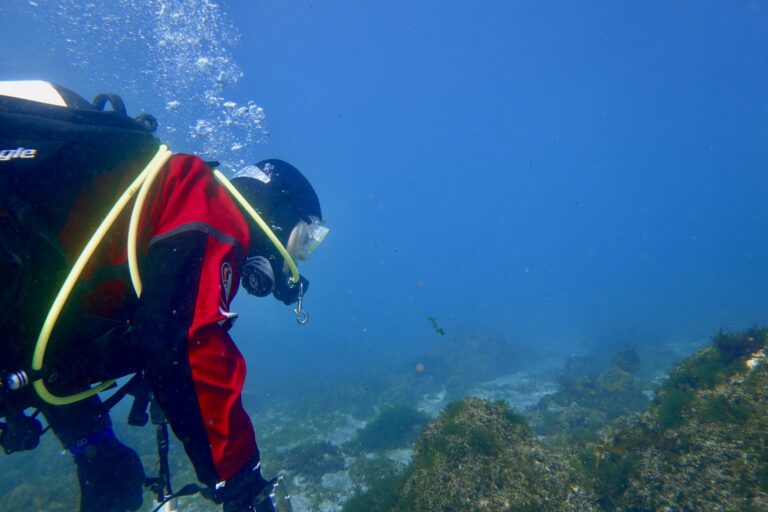
Planning the dive and diving the plan is one of the fundamentals of diving. This simple rule can be surprisingly tricky to follow. Here are a few good tips to help you plan the dive and dive the plan.
A dive plan reduces the risk of something going wrong during a dive. Incidents can be of many kinds and of varying severity.
A simple dive plan doesn’t need to be complicated and doesn’t require much organization.
Examples:
- Where to dive.
- How to enter and exit the water.
- Which route to take during the dive.
- What depth to go to.
- How long the dive should last.
- Who dives together in pairs.
- If there is more than one pair of divers, which teams dive together.
- Who leads the dive.
- What to do if a diver becomes separated.
- Who leads the debrief after the dive and where it takes place.
In-Depth Discussion
Diving is a buddy sport, and as with any team sport, it’s better for everyone to know the plan before setting out.
No one would think of organizing a 10 km race with just a start and a finish line. You need to decide on the route to be run, set up markers with water stations, and have a plan for what to do if someone gets injured during the race.
The same applies to diving. It’s not enough for the plan to simply be “go down and come back up.” You need to decide on the route and have a plan for what to do if someone becomes separated from the group and/or if a diving incident occurs. The plan needs to be simple to carry out.
A dive plan needs to be more or less detailed depending on the situation. This depends both on whether the divers know the site and know exactly what is being discussed, and on the risk involved in the dive. For example, technical divers need to make a detailed ascent plan, while recreational divers only have an optional 3-minute stop at 5 metres.
The dive plan is the framework for what we intend to do on the dive, and if anything in the plan is unclear or unacceptable because of the risk involved, it’s important for divers to discuss it before the dive begins and adjust the dive plan so as not to put themselves or others at risk.
A “what if” can be part of the original dive plan.
Various “what ifs” are fairly predictable in diving. One of them has to do with current.
It’s possible that we may need to deviate from the original dive plan if the current is stronger than expected. If we plan for that in the original plan, it can be built in. The plan is route A to B and from B to C and back to A, but if the current is strong we skip B and go straight to C, and it’s X who makes that call underwater.
It’s also possible that we may need to change the plan for unforeseen reasons. When that happens, the changes need to be discussed after the dive.
- What caused the changes.
- Did everyone understand the need for the change.
- Could anything have gone better.
- How do we want to handle this next time if we find ourselves in a similar situation.
A debrief after the dive helps us learn both from what went well and from what could have gone better. It strengthens good diving culture and builds trust within the group.
It’s important that everyone can contribute to the discussion, newcomers especially. Let’s not look for people to blame, but let’s not be afraid to point out what was done well and what could be improved.
With this approach we build up knowledge that makes us better divers and a better diving community.