
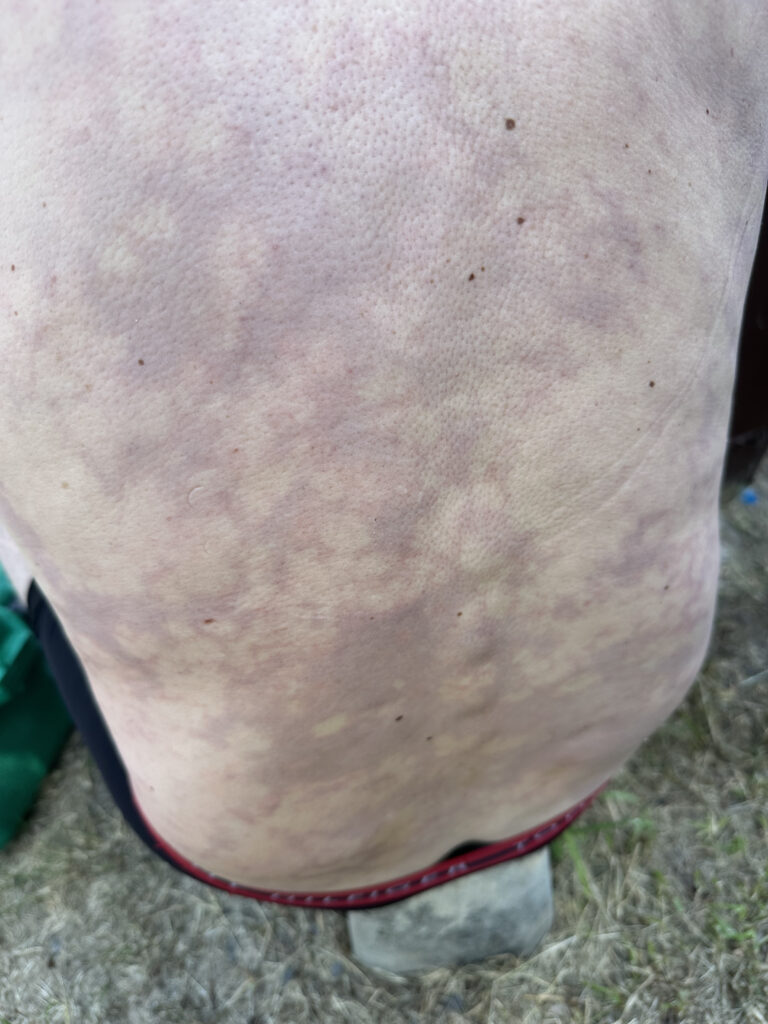
Decompression sickness can worsen rapidly once the first symptoms appear, so it is important to immediately contact 112 or the National University Hospital of Iceland (Landspítali) at 543 1000 and ask for the diving physician on call, who will advise on the next steps.
Decompression sickness is divided into two categories, decompression sickness type 1 (DCS 1) and decompression illness type 2, also called arterial gas embolism (DCS 2 / AGE). This article is not an exhaustive account of the causes and symptoms of decompression sickness, but rather a short summary in plain language.
Main symptoms of decompression sickness
- Skin discoloration – the skin takes on a marbled (mottled) appearance
- Pain in joints and muscles (often called “the bends”)
- Numbness or tingling
- Paralysis or muscle weakness
- Dizziness and loss of balance
- Difficulty breathing
- Chest pain
- Impaired consciousness or loss of consciousness
- Blood-tinged froth at the mouth
- In more severe cases: heart attack or stroke
Decompression sickness can worsen rapidly once the first symptoms appear, so it is important to immediately contact 112 or the National University Hospital of Iceland (Landspítali) at 543 1000 and ask for the diving physician on call, who will advise on the next steps.
First aid
- Call 112. If you cannot be sure that 112 will dispatch a diving physician, call 543-1000 yourself directly and ask for the decompression chamber team to be made available
- Begin immediate oxygen administration (100%, or the highest-oxygen nitrox available on site)
- Monitor vital signs
- Rest – it helps to keep the legs elevated above the head
Specialized care
Specialized care is directed by a diving physician and normally takes place in a decompression (hyperbaric) chamber.
Preventive measures
If the diver ascends slowly and steadily, the body is able to “off-gas” on the way up, and continues off-gassing after reaching the surface, through exhalation and through the skin.
Rule number one is therefore a slow ascent with a safety stop of 3 minutes at 5 metres. Then continue very slowly up to the surface from the 5-metre stop.
People can develop decompression sickness even when all procedures have been followed correctly. Causes can include:
- Repeated dives on the same day, or on several consecutive days
- Ascending too quickly at the end of a dive
- Underlying medical conditions or illness
- Unknown causes
To the diver
Decompression sickness is treatable in most cases, but can be life-threatening if nothing is done about it. It can also be life-threatening even when the person receives appropriate medical treatment.
You need to contact a diving physician immediately, who will assess the situation and arrange appropriate treatment if needed.
Decompression sickness is in many cases treated with inhalation of pure oxygen and in a decompression chamber. Treatment can be very costly, so the author of this article recommends that divers always carry valid dive insurance when diving abroad. Always keep your insurance policy number available. It can be put on a sticker on the back of your dive computer. Let your dive buddies know where you keep your insurance policy number.
The largest dive insurer in Europe is DAN Europe. Icelandic insurance policies generally do not cover extreme/fringe sports such as diving.
When choosing a dive operator abroad, it is worth checking whether:
- there is access to a decompression chamber, and how far away it is
- oxygen is carried on trips
- a recognized decompression-sickness response plan is in place
Air beneath the surface
At the surface we are under a pressure of about 1 bar. For every 10 metres descended, 1 bar is added. So the pressure is 2 bar at 10 metres depth, 3 bar at 20 metres depth, and so on.
In meteorology, the unit millibar is used for air pressure. A low-pressure system might be 988 millibar and a high-pressure system 1,022 millibar — 0.988 bar or 1.022 bar. But in diving it is precise enough to round surface pressure to 1 bar, or 1000 millibar.
The atmosphere is composed of the following gases:
- Nitrogen (N₂) ~78.08%
- Oxygen (O₂) ~20.95%
- Argon (Ar) ~0.93%
- Carbon dioxide (CO₂) ~0.04% (varies by region and season)
- Other gases (neon, helium, methane, krypton, hydrogen, and others) <0.01% combined
In diving, it is accurate enough to say that the air we compress into our cylinders and then breathe is about 21% oxygen and 79% nitrogen. The trace gases are such a small fraction that they are not included in diving calculations.
Nitrogen builds up in the muscles and tissues of the body while we dive. We cannot get rid of the nitrogen until the pressure decreases. The longer we dive, the more builds up in the body, and the deeper we dive, the faster it builds up. The maximum dive time for recreational divers is based on this saturation. Gas/air under pressure is compressed, but when the pressure decreases it expands again, all else being equal.
In its simplest form: if a diver ascends to the surface too quickly from a dive, the air bubbles expand on the way up because the pressure is decreasing. It is these air bubbles that contribute to decompression sickness.