
Buying diving equipment can be tricky. There are countless brands to choose from, and you can buy both new and used gear. It’s good to keep in mind that equipment needs to fit properly and be suitable for the conditions you’ll be using it in.
New Members
When buying diving equipment for the first time, it’s a good idea to consult not only the salesperson but also more experienced divers.
Many experienced divers know the pros and cons of equipment and know whether it suits, for example, Icelandic conditions if you intend to dive here at home.
Experienced divers also know whether the equipment can be serviced if needed.
Buying equipment that doesn’t suit you and that no one services is not a good investment.
New or Used?
Buying used diving equipment can be a good investment if the equipment is well maintained and fits you well. However, you should avoid buying equipment just because it’s cheaper.
On Facebook pages selling used diving equipment, you can often find very good deals. You can also find junk that people are trying to get rid of there. So it’s a good idea to consult experienced divers if newcomers are planning to buy used equipment on such pages.
Main Equipment
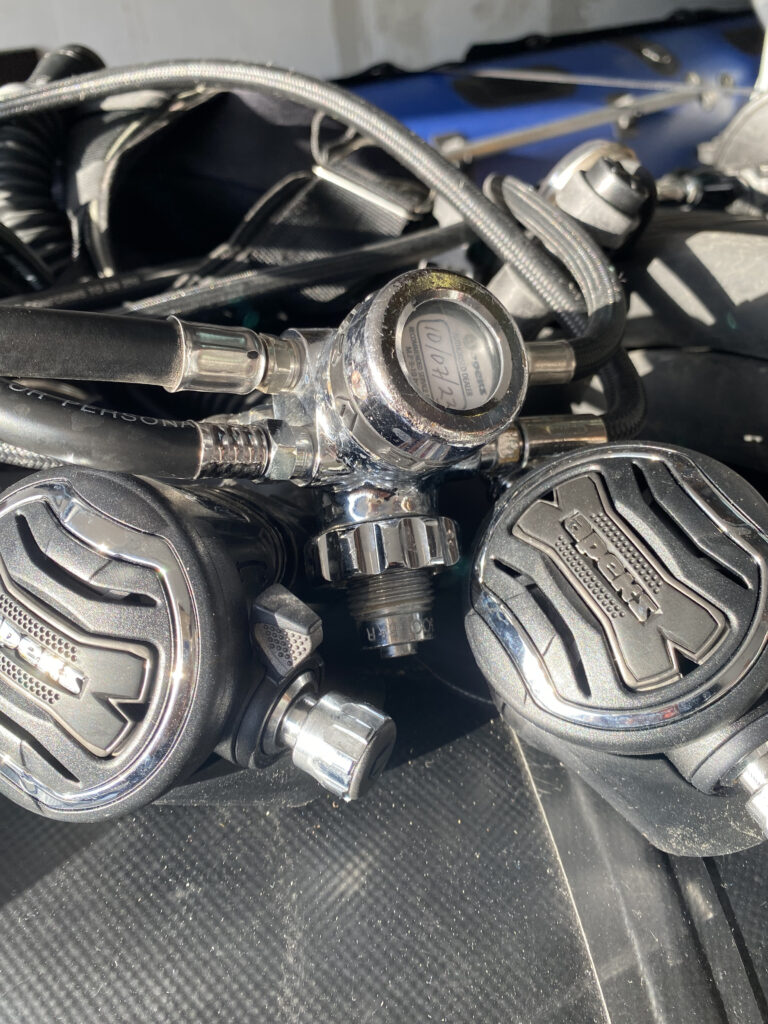
The most important thing when buying a regulator is to consider whether the equipment suits Icelandic conditions.
Many people have gone wrong by buying cheaper equipment abroad without realizing that it’s only intended for diving in warmer water than around Iceland. Note that a regulator brand can be the same, but one version is for warm water and the other for cold water, so the price difference is considerable.
The equipment needs to be “cold-water rated”, meaning able to withstand water temperatures down to around zero degrees.
It’s good to keep in mind that the equipment needs to be serviced regularly. It’s important that service providers are available here in Iceland for the equipment you plan to buy.
The following diving brands have authorized service providers in Iceland:
- Apeks
- Aqualung
- Poseidon
- Scubapro
If you know of authorized providers servicing other brands, feel free to send us a note and we’ll add the brand here.
A drysuit is one of the most expensive single items you’ll buy for recreational diving. A good suit can cost up to half a million ISK. (As of 2025, when this is written). You can take comfort in the fact that the suit can last you for many years if you take good care of it.
When buying a suit, keep in mind that it needs to fit.
If buying a new suit, a custom-tailored suit can be a much better purchase than a standard-size suit if the standard size only almost fits but not quite. The cost difference is often small, and that money is well spent.
It’s important that the length fits well, the boots/socks are the right size, and that you can move freely underwater without the suit restricting your movements.
Suits come either with a sock and separate boots worn over them, or with attached boots. The footwear needs to fit. – You wouldn’t hike up a mountain in boots that are far too big or too small, except maybe once, and you shouldn’t dive in a suit that doesn’t fit.
If buying a used suit, you need to make sure it fits and doesn’t leak. Suits can start leaking over time, which is often why they end up for sale. But suits are also sold when the owner has either stopped diving or is buying another suit for other reasons.
Suit Material
Suit material is usually divided into these three categories:
- Neoprene
- Cordura
- Trilaminate
Each type has its own pros and cons.
Before buying a suit, it’s a good idea to talk to fellow club members about which suit would suit you best.
A BCD is probably the piece of equipment that’s easiest to buy used. However, you need to keep in mind that it has to fit you and be suited to what you’re planning to do while diving.
There are different types available, and these are the main ones:
- Jacket BCD
- Backplate and wing (BCD wing)
- Sidemount BCD
When buying a BCD, check its lift capacity relative to the amount of weight you dive with.
It’s good to check whether weight can be integrated into the BCD if you want to avoid using a weight belt.
It’s also worth checking what kind of inflator the BCD has and where air can be released from.
If buying a used BCD, it needs to fit you, the inflator needs to work, and the BCD must not have any holes or leaks.
It’s possible that the inflator valve will need servicing and its O-rings replaced, or even that it will need to be replaced entirely after a few years.
Fins come in nearly every size and type.
When buying fins, they need to fit the footwear worn with your suit.
The same fins that fit the boots on your drysuit may not fit boots on a wetsuit if you’re planning to dive in warmer water.
The main types of fins:
- Rubber fins
- Plastic fins
- Full-foot fins
- Split fins
Rubber fins are recommended here in Iceland, since plastic tends to become very hard and inflexible in cold water.
Split fins aren’t well suited to the “frog kick”, so more experienced divers rarely use them, though they can work well in current when you need to swim vigorously. There are a lot of these fins for sale, and not without reason.
The main types of fin fastenings:
- Rubber straps
- Spring straps
The advantage of spring straps is that fins are easy to put on and nothing needs adjusting, unlike loose straps set over the heel and then tightened as needed.
A mask needs to fit closely against your face and seal well.
Here in Iceland, it’s best to use masks with a silicone skirt around the face rather than a plastic one, since silicone performs better in cold water.
When trying on a mask, it’s a good idea to hold it up to your face without the strap over your head and inhale gently through your nose. If the mask stays on your face, that’s a sign it fits.
Some masks are available with custom prescription lenses, and others can be fitted with reading-strength inserts.
Masks with custom prescription lenses can be very expensive, and it’s important that not just the lenses fit but the mask itself too. It can therefore be necessary to try on such a mask before buying it.
Masks with reading-strength inserts vary in price depending on whether the entire lens is replaced or a strength insert, a so-called “drop”, is glued onto part of the mask lens.
It’s not a given that masks sold at seaside tourist shops are suitable for diving. The lenses in some masks can’t withstand the pressure at depth.
When buying a used mask, it’s a good idea to check whether the strap holding the mask on your head is significantly worn, and whether the skirt is intact so the mask doesn’t leak.
Here in Iceland, it’s good to wear a 7 – 10 mm hood.
It’s important that the hood fits – not too tight and not too loose. The face opening needs to be large enough that you can tuck the mask skirt underneath it. The edge of the hood opening must not push the mask down.
Hoods with a zipper at the back are generally easier to get into, but the zipper can be difficult to pull, especially when wearing thick gloves.
When buying a used hood, keep in mind that hoods lose their insulation over time, so it’s necessary to replace them every few years. There’s nothing wrong with buying a lightly used hood.
The choice is between dry gloves or wet gloves.
Wet gloves are neoprene gloves, and it’s recommended that they be 7 -10 mm thick, unless you handle cold well, in which case 5 mm gloves can work.
It’s important that the gloves fit well and are suitably snug, but not too tight, since that’s what provides the best protection against cold.
Used wet gloves can be a good buy, but if the gloves are old and heavily used, they’ve likely lost a fair amount of their insulation.
Dry Gloves
A dry-glove system is available for most suits, but the system is generally a standard size and therefore doesn’t suit “large hands” well.
Dry-glove systems exist for several diving brands, and the systems can either be attached to the suit by yourself or fitted professionally.
For these systems, you can wear ordinary glove liners or special thermal gloves underneath the dry glove itself, which is a rubber glove. (A specific thicker rubber glove – not a dishwashing glove, though that can be used in an emergency).
When buying dry gloves, make sure to buy both the piece that attaches to the suit and the piece that goes on your hands. It’s not enough to buy just the glove part.
Keep in mind that the equipment is often sold in two or three pieces:
- The suit attachment ring
- The glove ring (with or without gloves)
- Gloves (liner/outer)
Dive lights are part of the standard equipment for diving in Iceland.
Abroad, it’s not always necessary to carry a light while diving, but here it’s practically essential, since visibility is lower.
It’s good to own two lights. A primary light and a backup. Both are brought along on every dive.
The backup light can be smaller than the primary light, or they can both be the same size, depending on their power.
When buying a light, it’s important to check the depth it’s rated for. Lights need to work down to at least 30 meters.
If buying a used light, you need to check that it works. You should also check whether the O-rings are intact.
It’s a safety essential to always dive with a buoy and reel on you.
Buoys and reels come in different sizes, and they also vary in whether they’re inflatable underwater or so-called surface marker buoys that you inflate at the surface.
Reels come with different lengths of line, but it’s good to aim for a reel with 30 meters or more if you’re doing deeper dives.
Which buoy divers choose is a matter of preference. The only requirement is that it’s large enough for you to signal your position on the surface if needed.
Buoy Color.
In recreational diving, the color of the buoy doesn’t matter.
In technical diving, color matters, which is why technical divers carry one yellow buoy and one orange buoy.
Knife, Line Cutter, Shears, and Whistle.
A knife, line cutter, shears, and whistle are items many divers won’t dive without.
These are rarely used items underwater, but they can be very important safety tools.
It’s recommended that newcomers get a good handle on buoyancy control and gain some diving experience before adding a camera.
Good starter cameras are the GoPro or other compact cameras.
If you want to take more demanding photos, you’ll need to look into what underwater housings are available for your camera.
It’s almost a rule of thumb that the housing costs about the same as the camera itself, sometimes even a bit more.
Once you have a larger camera and housing, you’ll need a bracket for the camera that a light can be mounted on. Then you’ll want some good lenses and other gear that isn’t very kind to your credit card.
As the man said:
“I just hope my wife doesn’t sell the camera equipment when I die for the price I told her it cost.”